


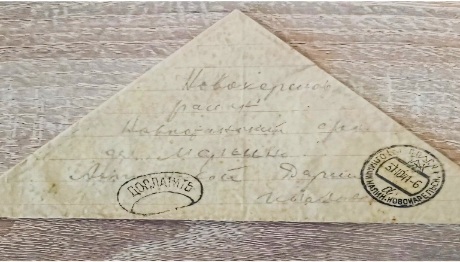
Researchers of the Institute of Linguistics, Literature and History KarRC RAS managed to collect letters from nine soldiers who wrote to their relatives in Karelian or with some phrases in Karelian as a result of the Interregional Marathon Letter Marathon "Hengen vägi muaman kieles" ("Morale in the native tongue"). All the letters were digitized and published online. Each letter is accompanied by a textual transcript and translation. Information about the author and the person preserving the letter is also provided. In addition, a list of resources available on this subject in other regions of the country and a list of literature and published sources were compiled.
"What makes this finding unique is that during the wartime the use of the Karelian language, lexically similar to the language of the enemy, was discouraged. That is why such sources are rather rare", – the project authors remark in the preface.
Scientists say that the authors of the letters used their native language to communicate something particularly important and intimate. It fortified the morale, gave them the power to live and fight.
During the project, researchers discovered so-called “Karelian” letters, which are not only historical artifacts, but also handwritten monuments of the Karelian language, which had for a long time had no standard written form.
"These letters, written by Karelians of the Karelian ASSR and Kalinin (now Tver) Region in Livvi, Karelian Proper, and Tver dialects, use both Russian and Latin characters. The language of the letters on the website written by the natives of Northern Karelia can be conditionally called Karelian-Finnish. The authors of these letters were fluent in the literary Finnish language, interlacing it with native dialectal (grammatical, lexical) forms", - the authors of the project explain.
KarRC RAS
in social media


in social media
News
May 11, 2025
Scientists have collected and digitized rare letters from the frontline written in Karelian
The results of a Marathon of letters in Karelian and Vepsian were published on the eve of May 9. During three months the Institute of Linguistics, Literature and History KarRC RAS conducted an interregional campaign, where participants were invited to share old letters from/to the frontlines written in the minority languages. As a result, more than 20 letters in Livvi Karelian and Karelian Proper were received. Scientists digitized them and published them with transcripts and translations on a special web resource.
The results of a Marathon of letters in Karelian and Vepsian were published on the eve of May 9. During three months the Institute of Linguistics, Literature and History KarRC RAS conducted an interregional campaign, where participants were invited to share old letters from/to the frontlines written in the minority languages. As a result, more than 20 letters in Livvi Karelian and Karelian Proper were received. Scientists digitized them and published them with transcripts and translations on a special web resource.
See also:

June 25, 2026
Admissions for 2026/2027 doctoral studies at KarRC RAS are underway
On June 20, Karelian Research Centre began accepting applications for doctoral studies. A total of 8 full-time positions are available this year, 6 of which are state-funded. The submission deadline is July 2.
Applicants willing to take a doctoral course at the Karelian Research Centre RAS can submit their papers between June 20 and July 2.
On June 20, Karelian Research Centre began accepting applications for doctoral studies. A total of 8 full-time positions are available this year, 6 of which are state-funded. The submission deadline is July 2.
Applicants willing to take a doctoral course at the Karelian Research Centre RAS can submit their papers between June 20 and July 2.

June 24, 2026
Scientists of the Karelian Research Centre RAS propose restoring Karelian forests using locally sourced and bred planting stock
Scientists of the KarRC RAS took part in a meeting of the Head of the Republic of Karelia, Artur Parfenchikov, with representatives of the scientific community, members of the regional Legislative Assembly, as well as heads of the republic’s agencies, enterprises, and organizations dealing with reforestation.
Speaking at the meeting, KarRC RAS CEO Olga Bakhmet and Director of the Forest Research Institute KarRC RAS Boris Raevsky focused on research results, analyzed the situation with forest regeneration in Karelia, and proposed recommendations for augmenting and accelerating forest regeneration using domestic production of seeds and seedlings.
Scientists of the KarRC RAS took part in a meeting of the Head of the Republic of Karelia, Artur Parfenchikov, with representatives of the scientific community, members of the regional Legislative Assembly, as well as heads of the republic’s agencies, enterprises, and organizations dealing with reforestation.
Speaking at the meeting, KarRC RAS CEO Olga Bakhmet and Director of the Forest Research Institute KarRC RAS Boris Raevsky focused on research results, analyzed the situation with forest regeneration in Karelia, and proposed recommendations for augmenting and accelerating forest regeneration using domestic production of seeds and seedlings.

June 23, 2026
Karelian Research Centre RAS will contribute to creating bio-ecovillages in the Arctic zone of Karelia
KarRC RAS leader Olga Bakhmet gave a talk at a working meeting with the leadership of the Kurchatov Institute, ministers, and CEOs of Karelian enterprises and organizations, chaired by the Head of the Republic of Karelia, Artur Parfenchikov. The talk focused on the development of technologies for bioeconomy and their application in bio-ecovillages.
KarRC RAS leader Olga Bakhmet gave a talk at a working meeting with the leadership of the Kurchatov Institute, ministers, and CEOs of Karelian enterprises and organizations, chaired by the Head of the Republic of Karelia, Artur Parfenchikov. The talk focused on the development of technologies for bioeconomy and their application in bio-ecovillages.