





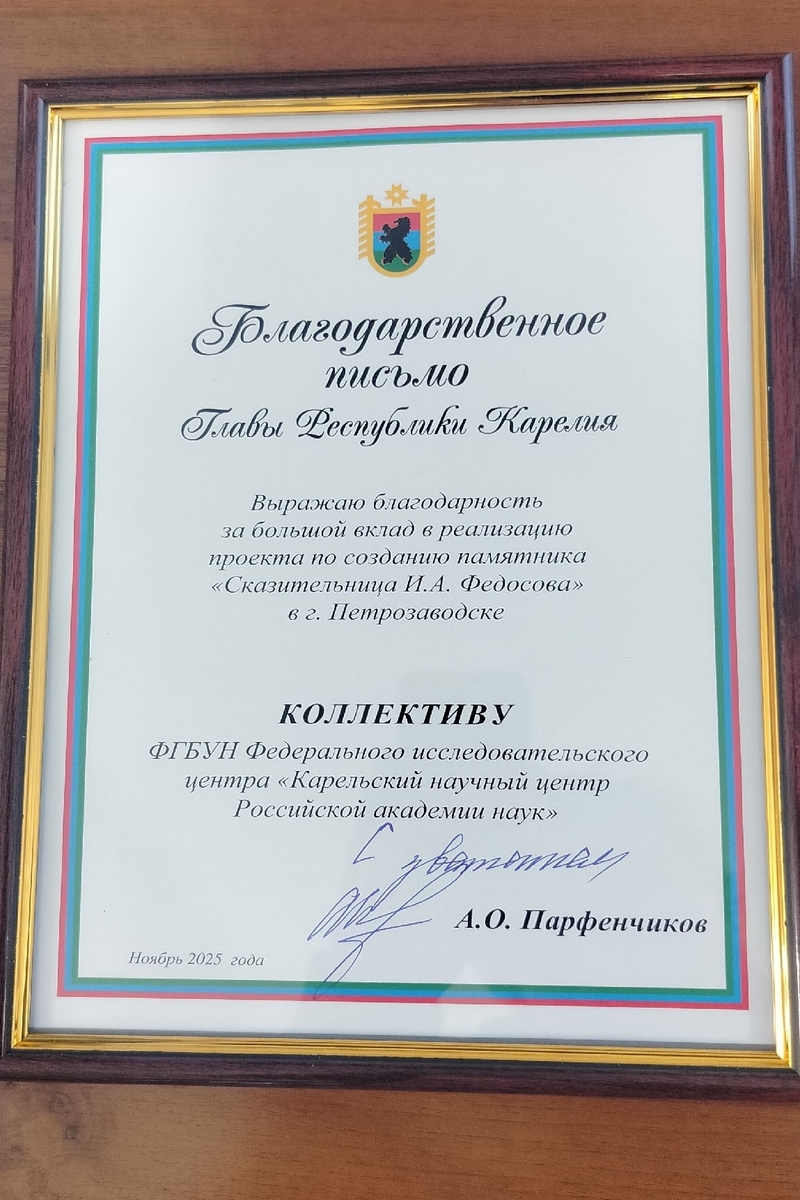
- I express gratitude for the significant contribution to the implementation of the project to create the monument of Taleteller I.A. Fedosova in Petrozavodsk – quote from Artur Parfenchikov's letter addressed to the team of the Karelian Research Centre RAS.
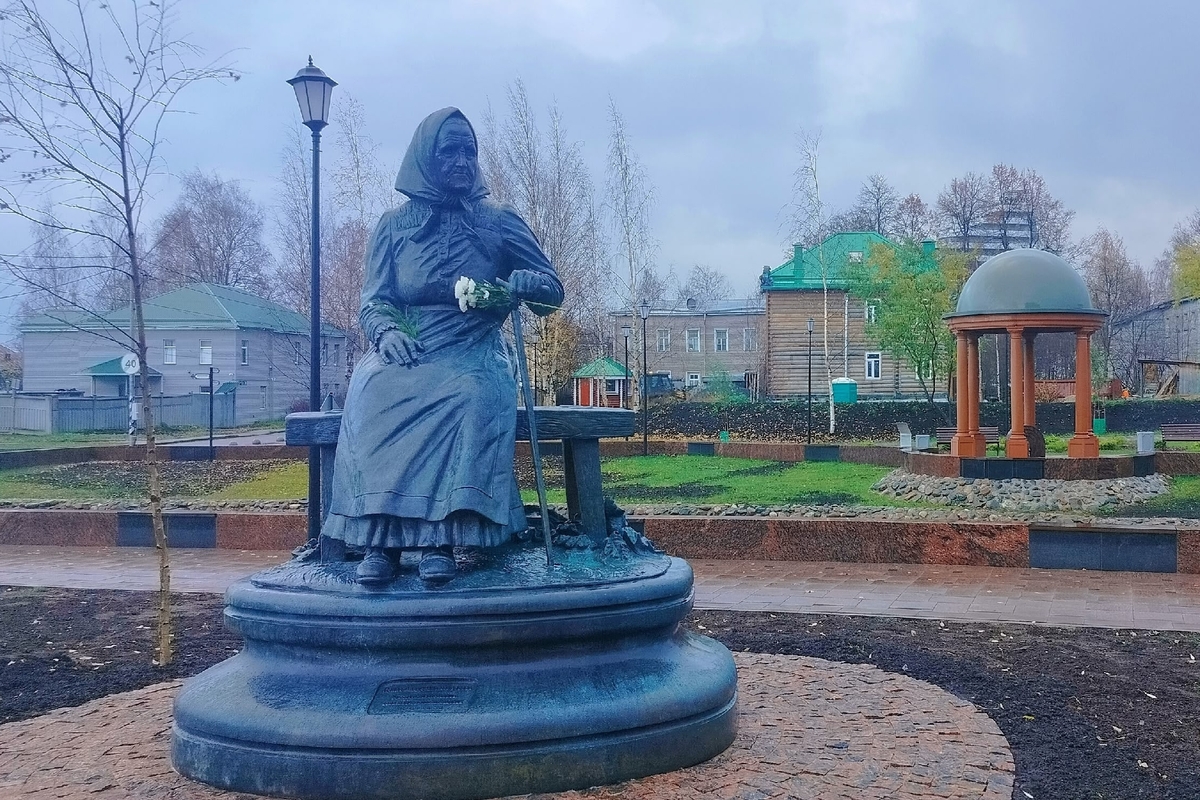
- It’s great news that this monument has been made, and it was placed in Fedosova Street, named after the taleteller. It’s one more step to conserving the culture. Quite a few employees of the Institute of Linguistics, Literature and History (ILLH) KarRC RAS are engaged in the conservation of languages, cultural traditions and customs, - pointed out Karelian Research Centre’s leader Olga Bakhmet. This year, the Institute of Linguistics, Literature and History KarRC RAS celebrated its 95th anniversary.
ILLH KarRC RAS Deputy Director for Science Yulia Litvin shared the details of the expert review of the monument. The Institute received the request for reviewing the monument’s model in October 2024. Originally, the authors of the model followed almost precisely the portrait of I. Fedosova published in the 1895 issue of the Niva magazine. It was a reproduction of a print of a photograph of I. A. Fedosova taken in the late 19th century by Elena Mrozovskaya, Russia's first woman photographer.
Diverging from the portrait and the print, the model used a photo where Irina Andreevna was sitting on a chest. The authors’ idea was that the chest would symbolize her rich life experience and possession of an invaluable treasure – knowledge of laments and oral folk art. Specialists at the Institute however commented that in the folk tradition the chest was more commonly associated with dowry, being its regular attribute. Also, the model lacked a cane, which the lamenter used to lean on. Meanwhile, we know that she sustained an injury in early childhood after falling from a horse. These details were taken into account when finalizing the model.
The review at KarRC RAS was produced by Irina Vinokurova, Dr.Sci. in History, Leading Researcher and Head of Ethnology Section ILLH KarRC RAS, and Yulia Litvin, Cand.Sci. in History, ILLH KarRC RAS Deputy Director for Science, Senior Researcher of Ethnology Section.
Outstanding taleteller and lamenter Irina Andreevna Fedosova was born in 1827 in the Village of Safronovo, Petrozavodsk Ujezd (district), Olonets Governorate – in the present-day Medvezhjegorsk District of Karelia. Being still a young girl, she became well-known in Zaonezhje as a wailer. Later on, she followed her husband to live in Petrozavodsk, and performed in Russia’s largest cities. Folklorists have recorded over 30 thousand verses after her, many of them of her own authorship. The most prominent representatives of Russian culture listened to Irina Fedosova; she made the folk genre of lamentations widely known.