





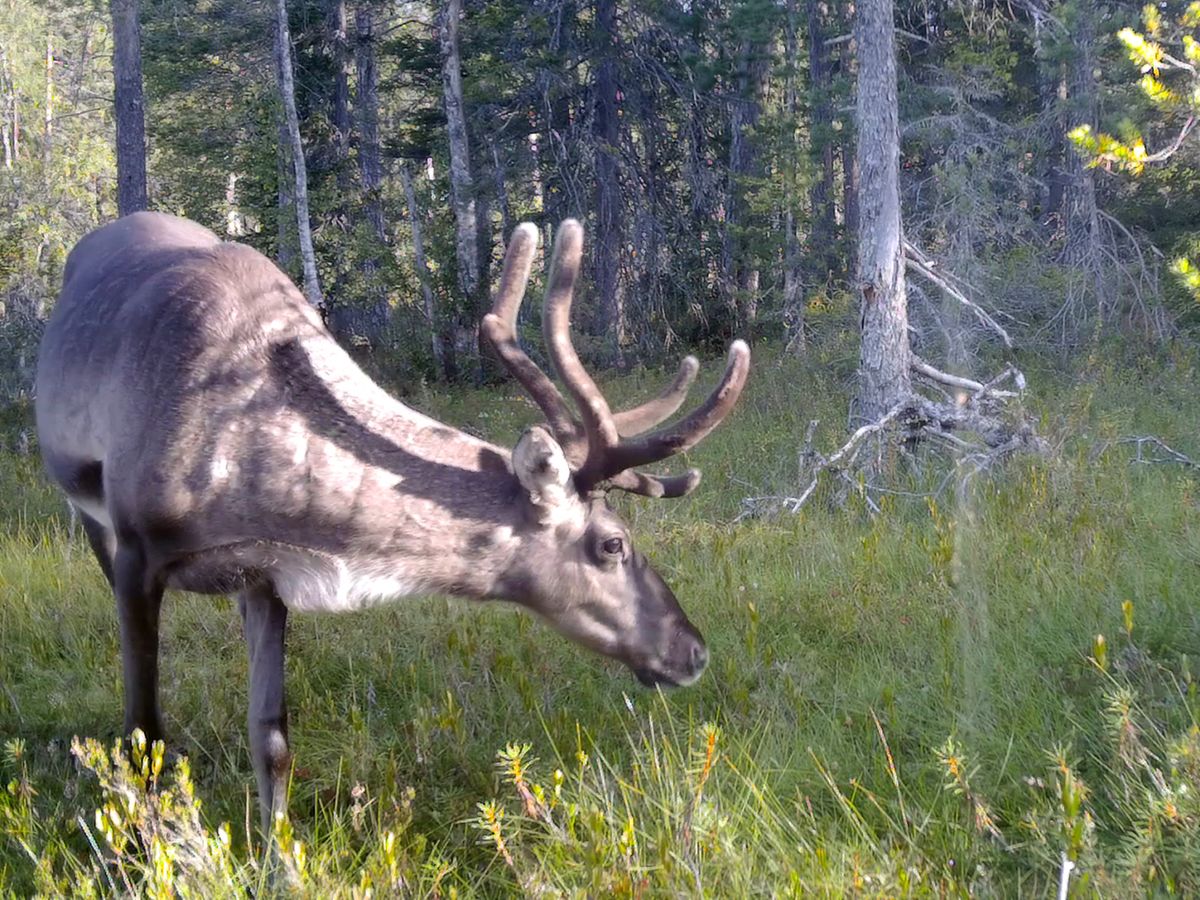
The forest reindeer is listed in the Red Data Books of the Republic of Karelia and the Russian Federation. Conserving the animal requires knowing its priorities regarding habitat, especially in previously disturbed areas. The scientists undertook to determine how the reindeer use different types of landscape with a prolonged history of intensive logging. This was achieved by analyzing data on the movements of three GPS-collared reindeer cows in the Louhi and Kem districts of Karelia during three years.
– We broke reindeer habitats down into categories: cutover areas of varying age, intact forest, mires, lakes. Then, we applied several mathematical analysis methods to assess their use by the animals, – shared Danila Panchenko, Senior Researcher at the Institute of Biology KarRC RAS, who headed the study.
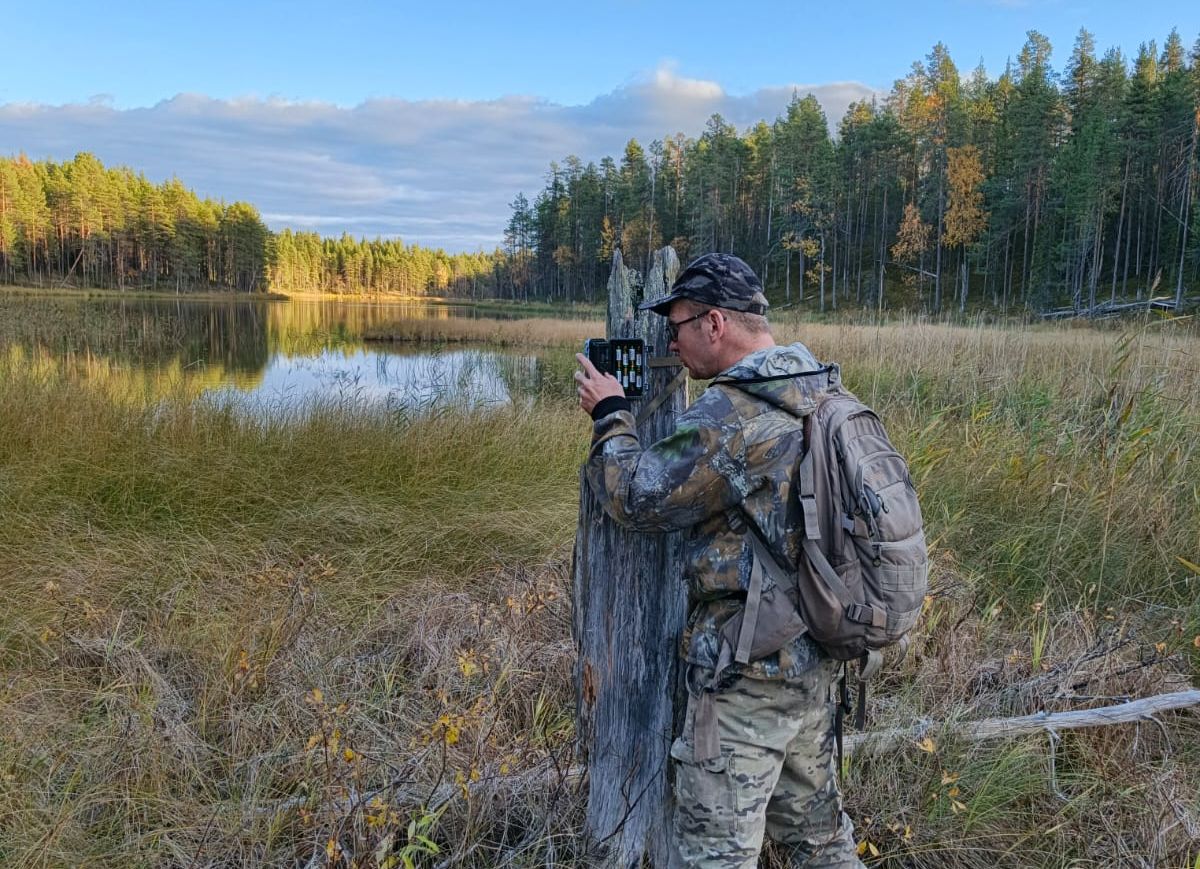
Senior Researcher of Zoology Laboratory IB KarRC RAS Danila Panchenko
checking on a wildlife camera trap. Photo: K. Tirronen / IB KarRC RAS
The finding is that the collared reindeer cows spent more than a third of their time throughout the year in intact forests, even though the proportion of such habitats in the study area was relatively small.
– Speaking of logging, the removal of old forests affects the animals’ wellbeing. This is first and foremost the loss of characteristic habitats. Logging during the summer nearly destroys the forest floor, depriving reindeer of food – lichens and subshrubs. On top of the reduced food capacity of the grounds, their protective properties are also altered. Open spaces make it difficult for the reindeer to hide from predators or poachers. Furthermore, clearcut sites have different snow conditions: the snow can be deeper than in the woods, impeding movement, – the scientist explained.
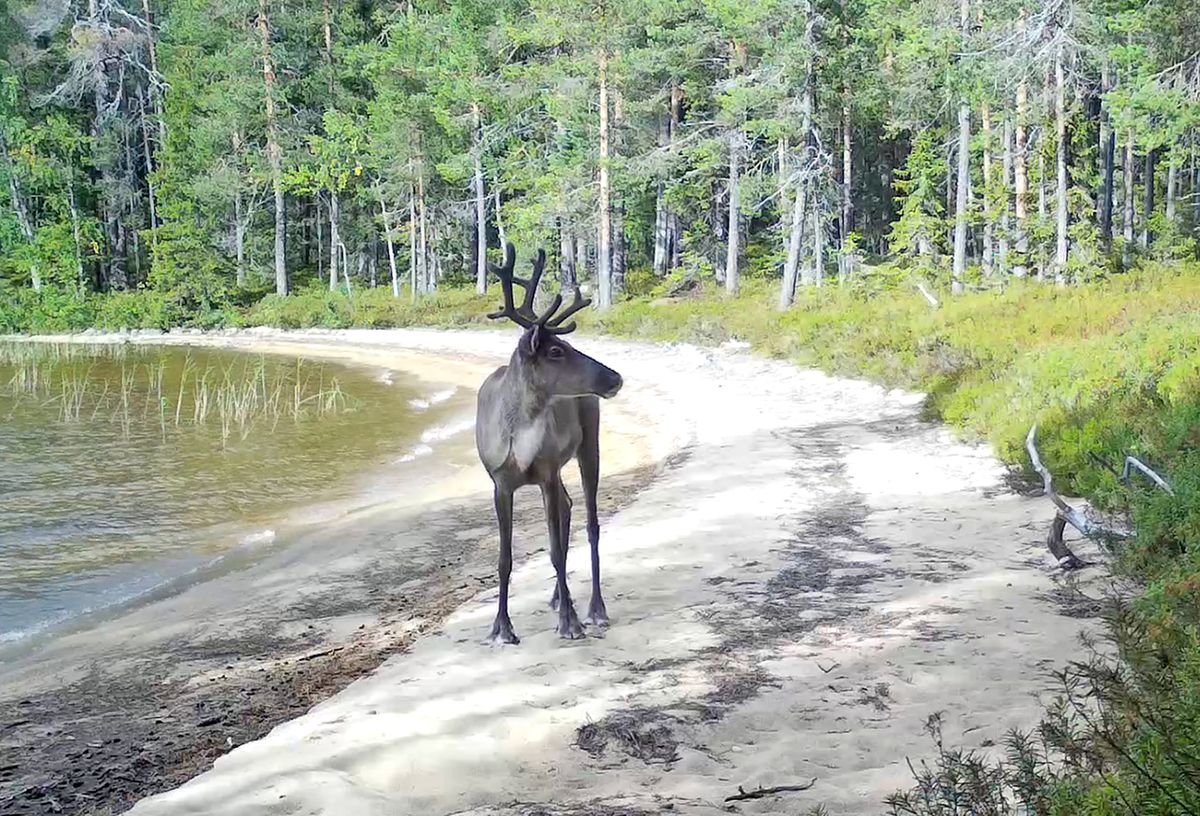
Forest reindeer. Image taken by a camera trap
The study is funded by the Russian Science Foundation within the project #24-24-00420 “Formation of the population-genetic structure of rare ungulate species under growing human pressure: case study of the wild forest reindeer (Rangifer tarandus fennicus Lonnb.) in North-western Russia”.
The forest reindeer population in Karelia has lately been at a steadily low level: scientists estimate it to be around two thousand individuals (vs. over six thousand in the late 1980s). The ways to conserve the animals include combating poaching on the one hand and preserving intact forests with a ban on their exploitation on the other.
– Intact forests must be conserved. One of the currently used approaches is protective forest areas. This status permits conserving areas essential for reindeer. This practice has not been applied in Karelia yet but we plan to work on that. An ideal solution would certainly be to create a network of large protected areas across the republic, considering that reindeer make use of extensive areas in the course of their life. Existing PAs, such as Paanajarvi and Kalevala National Parks and Kostomuksha Nature Reserve, are of crucial value – they act as refugia, where reindeer per se and their habitats in Karelia are conserved. However, there is now a need to establish PAs in other parts of the republic as well, – added Danila Panchenko.
Previously, researchers noted that a sharp decline in the forest reindeer population in the 1990s led to a fragmentation of its Northwest Russian distribution. This process can entail a loss of genetic diversity and impair individual viability due to inbreeding – crossbreeding between closely related forms within a population.
“Establishment of a network of protected patches within the core areas and along the seasonal migration pathways of this vulnerable species is a way to ensure continuity between Rangifer tarandus fennicus subpopulations across its range”, – concluded the authors of the article.