


The launch of the journal was timed to the 95th anniversary of the Institute of Linguistics, Literature and History (ILLH) KarRC RAS. The Learned Council meeting devoted to this event took place on October 28. At this meeting, Irma Mullonen, RAS Corr. Fellow, Doctor of Philology, the newly appointed Studia Nordica Editor-in-Chief, introduced the new journal. She proclaimed that the outlet is meant to promote and strengthen contacts between researchers in history and philology. The journal also plans to publish papers by young researchers, thus raising the next generation of scholars.
The journal was conceived as a professional forum for specialists in the humanities and social sciences who explore Northern Europe (Scandinavia and Finland), Baltic states and, of course, Karelia. The research geography can however be broader, encompassing other countries of the Baltic region and Northwestern Russia, especially Karelia’s neighbor regions. Importantly, the latter applies not only to the territory of the Republic of Karelia in its current administrative boundaries, but also to the entire Karelian historical and cultural space including, e.g., the modern Vyborg District of the Leningrad Region.
- The history and culture of Karelia, in a broad sense, can be interesting not only per se, but also in the context of other studies that do not explore Karelia directly. This could be studies of relationships between Russia and Europe at various levels and stages, the study of minority cultures and languages, etc. We’d like to contribute to having Karelia investigated in such broader contexts on the one hand, and getting it more often taken into account in such contexts on the other. And expanding professional ties between specialists of different profiles and even different disciplines is certainly one more of our goals, - said Deputy Editor-in-Chief, Cand. Sci. (Hist.), Senior Researcher of the NORDICA Interdisciplinary Research and Education Center Alexander Tolstikov.
According to the expert, most of the journal’s contributors so far are historians, linguists, and literary critics. In the future however, the editorial board intends to involve ethnologists, art experts, international relations specialists, and others. The journal’s initiators hope that the thematic extent and interdisciplinarity will help attract authors and readers with a wide variety of research interests, with different levels of training, and not only from Russia.
- While the journal is only developing, we need to attract established authors as well as young researchers. The idea is that there are many people who work on other matters, but then a topic of relevance for our journal “pops up” in the process. In this case, we’d be willing to provide a platform for publication with an appropriate reviewing standard and with access to a committed readership. The journal will bring together specialists focusing on this specific region, and this will attract authors from a wide variety of countries, - explained Alexander Tolstikov.
So far, only one issue has been published, but the plan is to have several a year. The journal will currently be published only in electronic form, offering open access.
- The experience of the Nordic and Baltic Studies Review proves the subject matter is much in demand. We felt this especially acutely after the closure of the Review. It became obvious that we need to support the community of researchers of the language and culture of North European countries and the Russian Northwest. New publications and networking are prerequisites for an environment in which opinions are exchanged, where new approaches and criticism spread faster. In this sense, our journal is a sort of a "condensation point" for the community of specialists united by interest in the region and the humanities, - stressed Alexander Tolstikov.
The first issue of the journal can be downloaded from the website of the Institute of Linguistics, Literature and History KarRC RAS.
KarRC RAS
in social media


in social media
News
November 12, 2025
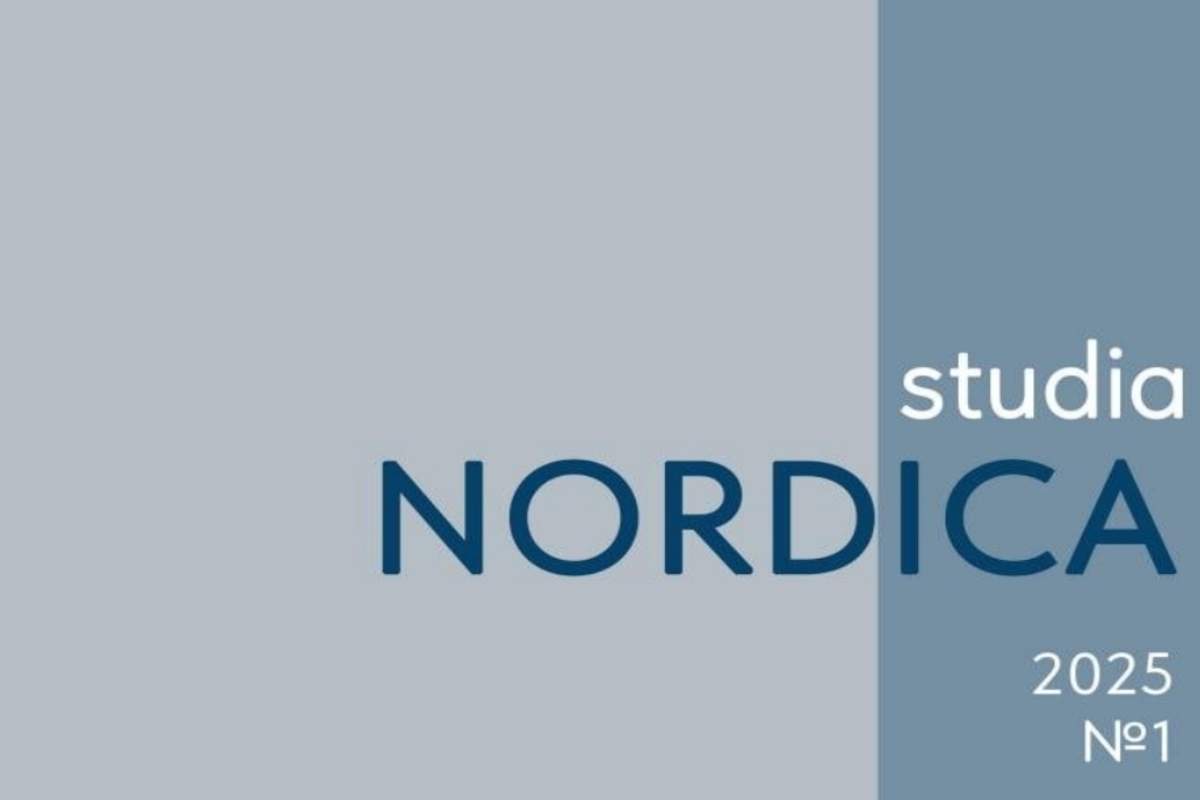
First issue of the new Studia Nordica journal is out at KarRC RAS
The first issue of the new online scientific journal Studia Nordica was published in October 2025 by the Institute of Linguistics, Literature and History of the Karelian Research Centre RAS. The journal succeeds to the Nordic and Baltic Studies Review published in 2016-2023, and is meant to continue and advance on the track set by the Review.
The first issue of the new online scientific journal Studia Nordica was published in October 2025 by the Institute of Linguistics, Literature and History of the Karelian Research Centre RAS. The journal succeeds to the Nordic and Baltic Studies Review published in 2016-2023, and is meant to continue and advance on the track set by the Review.