
News
November 14, 2025
PORA and Karelian Research Centre RAS signed a cooperation agreement

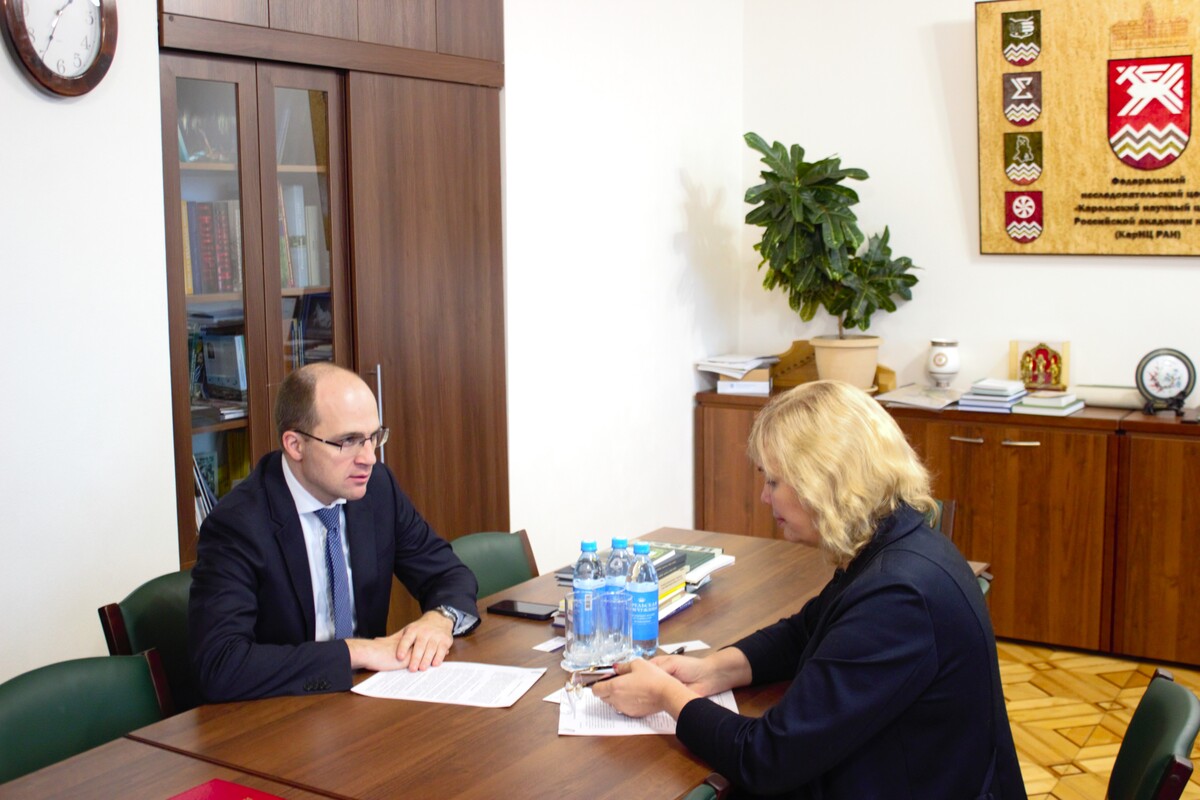
On November 14, Karelian Research Centre of the Russian Academy of Sciences and Project Office for Arctic Development (PORA) signed in Petrozavodsk a Strategic Partnership Agreement. The document was undersigned by PORA Director General Maxim Dankin and KarRC RAS Acting Director General Olga Bakhmet.
The agreement documents the commitment to develop long-term cooperation in the study and preservation of the natural and cultural heritage of Arctic regions. The parties have agreed to build a partnership based on mutual benefit, equality and exchange of competencies.

The agreement envisages joint research, preparation of analytical materials, conferences, seminars and round tables. The document also provides a framework for planning and implementing projects and programs to support basic and applied research, upgrade scientific work, and promote the results produced by Arctic science.

The Project Office for Arctic Development regularly implements initiatives in the Republic of Karelia. Completed and ongoing projects include those of the cultural education program «PORA. Time to visit…Karelia!», designed to support the region’s small museums and popularize the local cultural heritage.

Scientists of KarRC RAS in collaboration with PORA support a study on child sleep characteristics in northern regions, which investigates the effect of Arctic conditions on the health of schoolchildren.


In 2019, PORA organized strategizing sessions in Petrozavodsk to work out proposals for the Arctic 2035 Strategy, including development of Belomorsk port infrastructure and improving the quality of life in Arctic territories.

Karelia was also a venue for the projects Arctic Volunteer, in which citizens are trained as public environmental inspectors, and the Arctic Clean-up Day, which annually unites volunteers for local environmental improvements.

Besides, the region participates in the Polar Index analytical project, which helps assess the sustainability and quality of life in Arctic regions of Russia and establish an open dialogue between science, authorities and experts.

See also:

January 10, 2026
New light scattering model to help assess and predict the state of marine systems

An international research team has developed a three-stream model of light scattering in the sea. It processes satellite data on the incoming and emitted light fluxes into information on water characteristics: presence of impurities, phytoplankton concentration, pollutants, and other parameters. The system of equations for this study was written by Ilya Chernov, Senior Researcher at the Institute of Applied Mathematical Research KarRC RAS. The model has been successfully tested in the Mediterranean Sea, and researchers are interested in trying it in application to the Arctic.
January 8, 2026
Karelian scientists surveyed the Mekong River Delta within a Russia-Vietnam project

Researchers from the Institute of Biology KarRC RAS Viktor Voronin and Dmitry Bityutsky took part in an expedition to the Mekong River Delta in Vietnam, which collected biological material for assessing the ecological status and biological resources of the Mekong Delta using biochemical profiling methods within an international cooperation initiative.
January 5, 2026
Archaeologist Svetlana Kochkurkina: “I wrote this book out of gratitude to people of Kurkijoki Village”

The new book "Kurkijoki. Archaeology, History, Culture" has turned into a notable event for the academic community, as well as for enthusiasts of Karelian archaeology and history. The authors of the monograph are Svetlana Kochkurkina, Leading Researcher, Archaeology Section ILLH KarRC RAS, and Marina Petrova, Director of the Kurkijoki Local Lore Centre. The work summarizes the findings from many years of research into the archaeology, history, and culture of the Kurkijoki Village and its surroundings.